
TDI: 4 Slices vs 8 Slices
Maximising return on investment from both CAPEX and OPEX is a constant challenge for food inspection equipment manufacturers and end users alike. At the same time, the industry continues to demand improved detection performance, higher throughput and lower false reject rates.
These requirements created the perfect value-engineering challenge for our detector development team.
In a conventional TDI architecture, increasing the number of slices requires additional photodiode pixels and a wider X-ray beam to illuminate them. While this can improve signal-to-noise ratio (SNR), it also increases system complexity, detector cost, X-ray source loading and long-term servicing requirements.
The question we asked was simple:
Can we achieve the same detection performance with fewer slices?
Recent trials using Sens-Tech’s proven 0.8 mm pitch XDAS stacked dual-energy photodiode technology have provided a clear answer.
Same Performance, Half the Detector Hardware
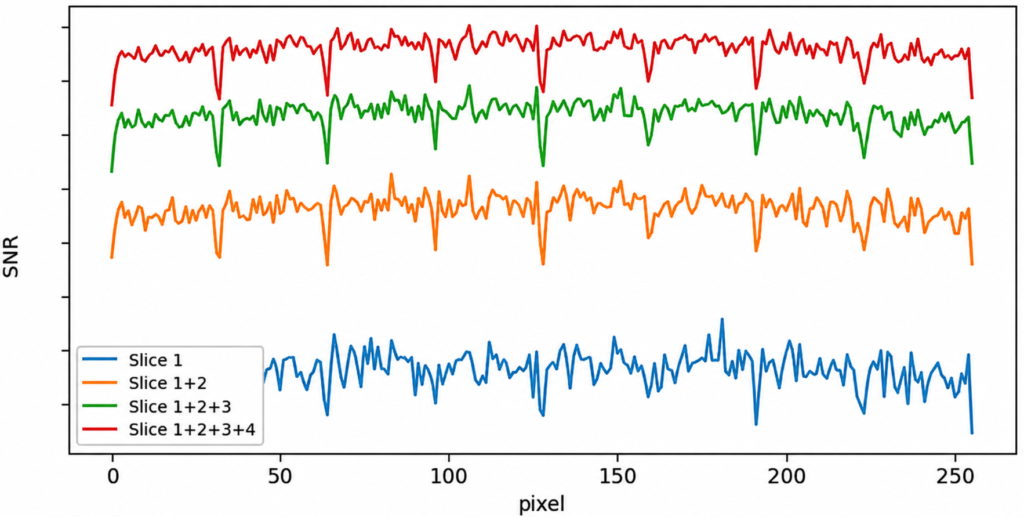
Using stacked low-energy and high-energy photodiodes, we compared a 4-slice TDI architecture against our original 8-slice design.
The results showed that four slices delivered the same excellent fish bone detection performance as eight slices, including the ability to detect extremely small contaminants in challenging food products.
This means that food inspection system manufacturers can benefit from the advantages of TDI without the additional cost and complexity traditionally associated with higher slice counts.
The Benefits
Reduced Operating Costs
A four-slice architecture allows the X-ray beam width to be significantly reduced compared with an eight-slice system. This reduces X-ray source loading and can contribute to lower operating costs over the lifetime of the machine.
Additional savings are realised through:
- Fewer detector channels to maintain and calibrate
- Reduced photodiode count
- Lower servicing and replacement costs
- Simplified system integration
Reduced Capital Costs
The reduced detector area and lower channel count also contribute to a more cost-effective inspection solution, helping OEMs and end users achieve a faster return on investment.
Proven Detection Performance
Most importantly, these cost reductions have been achieved without compromising detection capability.
Our testing confirms that four slices represent the optimum balance between performance, complexity and cost for this detector architecture.
Ready for Evaluation
Following these successful trials, Sens-Tech is now building the first production batch of LINX-TDI-DE cameras for customer evaluation and system integration.
A new datasheet is now available detailing the latest specifications and performance characteristics.
Download the LINX-TDI-DE Datasheet
If you have not already done so, you can also request our white paper to learn how dual-energy TDI imaging enables the detection of fish bones as small as 0.3 mm in high-speed inline inspection systems.